

- Story
Caring is part of being human
24.06.2026 The Feminist Strike Day and the 30th anniversary of the Gender Equality Act are turning the spotlight on care work. Two BFH experts explain why care work is crucial – and how BFH can help bring about change.
Key points at a glance
- Caregiving and equal opportunities are fundamental aspects of being human and affect us all.
- Care work must be given greater recognition – of a financial nature too.
- BFH can play a major role in shaping how care and equal opportunities are addressed in society.
The historic Women’s Strike of 14 June 1991 turned the spotlight on structural inequalities, pay discrimination and gender-based violence. Since the second big Strike Day in 2019, the 14th of June has become an annual day of feminist strike action in Switzerland. It raises awareness of just how vital women’s work is to the functioning of society and the economy – and how unequally this work is still valued today.
The history of the Feminist Strike is closely linked to the development of gender equality policy in Switzerland. On 1 July 1996 – 30 years ago – the Swiss Gender Equality Act came into force. Despite legal progress, significant disparities still remain in terms of pay, pensions, political representation and the distribution of unpaid work.
We sit down with Carolin Fischer, Head of the strategic thematic field Caring Society, and Lucia M. Lanfranconi, Co-Head of the Equal Opportunities Office, to discuss progress, blind spots and how universities such as BFH can help boost the status of care work.
You can also listen to the conversation between Carolin Fischer and Lucia Lanfranconi in German:
Carolin Fischer and Lucia Lanfranconi, how do a caring society and equal opportunities complement each other – and where do they differ?
Carolin Fischer: Equal opportunities are a key cross-sectional issue for a caring society. And a caring society is inconceivable without equal opportunities. So we complement each other in that where there are specific measures in our thematic field that foster equality of opportunity, we embed them in a broader discourse and highlight the connections between them.
I see the distinction above all in our respective areas of competency. The Equal Opportunities Office places more of an emphasis on BFH’s responsibilities as an organisation, whilst the thematic field promotes research and teaching for a caring society and raises BFH’s profile in this field.
Lucia Lanfranconi: We really do work hand in hand. One way of describing it would be to say that the Equal Opportunities Office is working with other stakeholders to help BFH become a caring institution. At the same time, in my role as Professor of Diversity, Equity & Inclusion, I am very closely involved with this thematic field – through research, projects and events. So there are many overlaps.
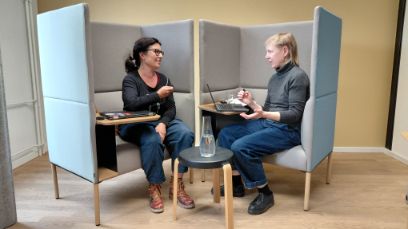
The interviewees: Carolin Fischer and Lucia M. Lanfranconi
Carolin Fischer is Head of the strategic thematic field Caring Society at BFH and a lecturer at the Institute for Social and Cultural Diversity. In this role, she aims to address the concept of a caring society comprehensively from a range of different perspectives. She understands the term ‘caring society’ as a society in which not only the wellbeing of the people, but also solidarity, justice and opportunities for participation guide the actions of all stakeholders. Consequently, many activities in this area centre on the question of how we can foster a caring society, what stakeholders we should involve, and what the exact nature of the meaningful contributions could be that BFH is well-placed to make.
Lucia M. Lanfranconi is Co-Head of the Equal Opportunities, Diversity and Inclusion Office (ODI) at BFH, Professor of Diversity, Equity and Inclusion at the Business School and, from the autumn semester, Head of the master’s programme in Social Work at the Bern campus. The office’s primary remit is to embed ODI within BFH at both a strategic and operational level and in all performance mandates. The office shares responsibility for ensuring that the topics mentioned above are not only researched but also translated into practice by staff and students within BFH. For this, the office has drawn up an action plan (German PDF) outlining various measures.
From your perspective, how has the social status of care and care work changed over the past 30 years?
Carolin Fischer: Both paid and unpaid care work still don’t receive the recognition they deserve, either financially or symbolically. Yet caregiving and care work are a universal human need and an important form of human connection. There are so many ways in which we can make care the foundation of our thinking and actions, yet most of them are not taken up. But I also see many initiatives that are helping to build a caring society – at BFH too. These initiatives need to be better coordinated in order to achieve greater visibility and have a greater impact, and to demonstrate just how wide-ranging care issues are.
Lucia Lanfranconi: Thinking back over the past 30 years, there has definitely been progress: in my SNSF project, which examines gender equality in social welfare over the last 30 years, it is plain to see just how much the childcare landscape has changed. There has also been progress in society as a whole – it has become more normal to see women in leadership roles, for example, or fathers working part-time.
But there is still much to do. The findings of the 2021 National Equality Barometer – a representative survey conducted in Switzerland on the compatibility of paid work and care work – were clear: people in Switzerland would like to see a fairer division of care work within couple households – incidentally, a desire shared by people of all genders – as well as more structural support, such as the option to work part-time, affordable childcare, more parental leave and greater societal recognition of both paid and unpaid care work.

People in Switzerland would like to see a fairer division of care work within couple households.

What developments in the field of gender equality and care work have surprised you in recent years?
Lucia Lanfranconi: The Covid pandemic had a very drastic impact. Working from home gained momentum and care work suddenly entered the public eye, yet in many families it has continued to fall mainly to women, as recent research shows. Unfortunately, as a society, we seem to be regressing again. This makes it all the more important that we, at BFH, remain true to our principles and actively champion equal opportunities, diversity and inclusion.
Carolin Fischer: I was encouraged by the strong support for the 2021 Nursing Initiative. It was the expression of a deep appreciation for carers. This makes the sluggish progress in implementation all the more sobering. It shows just how far we still have to go. I am very pleased to see a growing focus on care and a caring society within academia, the arts, literature and activist circles. Many of these discussions take place within a transdisciplinary dialogue, to which projects made possible by the thematic field of Caring Society also contribute. The fact that initiatives like this thematic field can become reality is one of those rays of hope for me, especially in the current context.
Is there still a need for a Feminist Strike Day today?
Carolin Fischer: We need a ‘14th of June’ 365 days a year. Joking aside, this symbolic day raises public awareness of the inequalities that shape our daily lives and our society as a whole. For me, the 14th of June also shows that we are not alone in tackling these issues proactively and from a wide range of perspectives.
Lucia Lanfranconi: Yes, unfortunately, we still need a 14th of June, also with respect to equal pay. In a recent interim assessment of the implementation of the Gender Equality Act, we were able to demonstrate that companies don’t always implement the legal requirements on equal pay correctly. That’s something we need to look into. In addition to the Feminist Strike Day, we need other days throughout the year that highlight structural inequalities and discrimination beyond the gender category.
We need to view care even more as a shared need and everyone’s shared responsibility.

What role do universities play in promoting a caring society? What exactly is BFH doing?
Carolin Fischer: Institutions of higher education can play a vital role in driving forward the mainstreaming of care. The topic of caregiving and responsibility for care can be integrated into all disciplines. Not only does this bring out the many different facets that make up care, but research and teaching can also help to develop caring infrastructures, practices and approaches. BFH is currently running a wide range of projects in this area, involving all its schools.
Lucia Lanfranconi: As a university, we have a major responsibility, as we are shaping the next generation of experts and practitioners. The Equal Opportunities Office works with others at BFH to create opportunities for discussion, raising awareness and bringing about change, such as through Sexual Harassment Awareness Day on 21 April. We want to raise the profile of diversity issues both within and outside BFH, for example through training on unconscious bias, through the new pool of experts, through our research, or events such as the film and discussion evening to mark the anniversary of the Swiss Gender Equality Act on 1 July. This lets us bring different perspectives into society and help to shape its evolution.
From your perspective, which societal narratives about care work would need to change in order to make true equality possible?
Carolin Fischer: I care about care! We need to view care even more as a shared need and everyone’s shared responsibility. We all give care, but we also all receive it in very different ways. Caregiving shouldn’t always be thought of in connection with illness or special need situations, but simply understood as a fundamental part of being human. Many stakeholders can help to ensure that caregiving is valued more highly, both financially and symbolically: from schools to the private sector and interest groups, right through to politics.
Lucia Lanfranconi: I agree with Carolin: care affects us all. We all need to play our part: at home, in organisations and businesses, and in the public sphere. I take a sceptical view of the current radicalisation tendencies in society. I wish everyone would focus more on what we have in common rather than on individual interests, on what connects rather than on what polarises.
Thank you for this interview!