Information events
Do you have questions about the MSc in Life Sciences – Food, Nutrition and Health at BFH? Then take part in one of our information events.


The MSc programme in Food Science at BFH provides you with solid methodological knowledge and prepares you specifically for the challenges in food production and human nutrition.
Benefit from the combined expertise of four Swiss universities of applied sciences and deepen your skills along the entire value chain – with the MSc in Life Sciences – Food, Nutrition, and Health.
You have the choice between studying full-time or part-time alongside your professional activity.
The MSc in Life Sciences – Food, Nutrition and Health trains you in established methodologies and equips you for the challenges of food production and human nutrition.
.jpg)
Do you have questions about the MSc in Life Sciences – Food, Nutrition and Health at BFH? Then take part in one of our information events.
Keine Veranstaltungen gefunden.

The market for speciality foods is booming, opening new opportunities for development in the food industry. Meanwhile, topics such as food waste and natural resource consumption have entered the public debate. With the MSc in Life Sciences – Food, Nutrition, and Health, you will acquire the necessary knowledge to bridge the gap between what is technically feasible and what is socially desirable.
The MSc in Life Sciences – Food, Nutrition and Health:
trains you in established methodologies and equips you for the challenges of food production and human nutrition.
provides you with insider access to the food and nutrition industries, by means of guest lectures, excursions and case studies.
is taught within an international context, with instruction in English.
offers full flexibility: you can study full- or part-time.
offers a unique opportunity to benefit from the expertise and skills drawn from four Swiss universities of applied sciences.
enables you to take on demanding roles in product development or public health nutrition.
introduces you to important actors in the food and nutrition industry.
“I chose this master because it incorporated different aspects of food, such as nutrition and the science side of it which I enjoy,” says Amy Marshall.
This Food Science master's program is the result of close cooperation between schools specializing in food and nutrition studies at Swiss universities of applied sciences. This ensures a solid, hands-on approach.
Three partners each contribute their specific expertise:
The Food, Nutrition and Health degree programme is part of the Master of Science in Life Sciences, which is offered in cooperation with four Swiss universities of applied sciences:

The MSc in Life Sciences – Food, Nutrition, and Health equips you with the skills that employers in the industry require for management positions: You are a specialist with practical experience who takes a scientific approach and manages complex projects with ease.
This interdisciplinary master’s programme will prepare you for research and management positions in the Swiss food and nutrition industry. You will also be qualified for challenging positions in multinational food companies or international organisations dealing with nutrition.
Management positions can be found, for example:
“Currently, I’m working as an intern here in the 3D printing lab at the HAFL. We essentially 3D print food! We maintain many of the 3D printers and are also involved in product development, particularly in finding materials that can be printed,” says Akshay Shah.

Our Food Science programme is entirely modular. This allows you to select the modules that appeal to your interests and accommodate your work or family obligations. Independent study accounts for much of the programme.
Specialisation modules form the core of your degree programme. There you will learn the most important aspects of developing nutritionally valuable foods and how public health can be influenced by nutritional measures.
You may select from a range of modules, which allows you to customise your studies based on your strengths, interests and area of focus.
You will conclude your studies with a master’s thesis. This is generally embedded within a project at one of the three participating schools or is conducted together with one of their research partners. You may do it with an outside research or industry partner, such as your employer.
| Master’s thesis – the core of your studies | 30 credits | |
| Specialisation modules | min. 30 credits | |
| Cluster-specific modules (Food and Environment) | min. 9 credits | |
| Core-competence modules (Data and Business Management) | min. 12 credits |
| Code | Module title | ECTS | ||
| Specialisation modules – compulsory-elective | ||||
|---|---|---|---|---|
| FNH-1 | Food Quality and Safety from Farm to Fork | 5 | ||
| FNH-2 | Food Regulation and Consumer Perception | 5 | ||
| FNH-3 | Technology meets Nutrition | 5 | ||
| FNH-4 | Food for Specific Target Groups | 5 | ||
| FNH-5 | Bioactive Food Ingredients | 5 | ||
| FNH-6 | Public Health Nutrition | 5 | ||
| FNH-7 | Current Issues in Food, Nutrition and Health | 5 | ||
| Minimum required | 30 | |||
| Further specialisation modules – after consultation 1 | ||||
| AF-01 | Applied Research in Natural and Social Sciences | 5 | ||
| AF-02 | Knowledge Management and Sharing in Agriculture and Forestry | 5 | ||
| AF-03 | Integrated Natural Resources Management | 5 | ||
| AF-12 | Consumer Behaviour, Markets and Trade | 5 | ||
| AF-13 | Corporate Social Responsibility and Sustainable Business | 5 | ||
| AF-21 | Expansion of Personal Scientific Knowledge | 5 | ||
| AF-22 | Holistic Assessment of Production Systems | 5 | ||
| AF-23 | Optimisation of Production Systems in Agriculture and Forestry | 5 | ||
| AF-32 | Policies and Institutions as Drivers for Development and Innovation | 5 | ||
| AF-33 | Rural and Regional Development in Practice | 5 | ||
| Core competence modules – compulsory-elective | ||||
| B1 | 3 | |||
| B2 | 3 | |||
| B3 | 3 | |||
| B4 | 3 | |||
| D1* | 3 | |||
| D2* | 3 | |||
| D3* | 3 | |||
| D4 | Data and Ethics | 3 | ||
| Minimum required * One of the modules D1, D2 or D3 must be successfully passed |
12 | |||
| Cluster-specific modules – compulsory-elective | ||||
| F1 | 3 | |||
| F2 | 3 | |||
| F3 | 3 | |||
| F4 | 3 | |||
| F5 | 3 | |||
| F6 | 3 | |||
| E2 | 3 | |||
| E3 | 3 | |||
| E5 | Biodiversity | 3 | ||
| Minimum required | 9 | |||
| All areas | Minimum required (has to be completed by taking additional modules from the four areas) 2 | 60 | ||
| Thesis | Required from master’s thesis | 30 | ||
| Total | Minimum required 2 | 90 |
To enrol in the MSc in Life Sciences – Food, Nutrition, and Health, you must have a Bachelor of Science degree in a related field and a good command of English.
You will be accepted into the programme if you have completed a Bachelor of Science in one of the following fields of study, at a Swiss university of applied sciences, with a grade of at least 5 or if you have an ECTS grade of A or B:
Candidates who have an equivalent previous education and professional experience will also be considered for admission on a case-by-case basis. The Head of Degree Programme reviews and determines the equivalence of your previous education and professional experience.
Do you have a bachelor’s degree from an academic university? If so, you must provide evidence of at least half a year of full-time professional experience in a relevant field.
Lessons are held in English. Therefore, it’s recommended that you have at least B2-level language skills, as per the European Language Portfolio. You may write your master’s thesis in Englisch, German or French.
We review each international application individually. If you have any questions, please contact msc-fnh.hafl@bfh.ch before submitting an official application.
The cost of study includes tuition and examination fees, as well as costs for teaching materials and excursions.
At BFH, different fees apply for programmes and examinations.
| Application fee (per application)* | CHF 100 |
| Tuition fees (per semester) | CHF 850 |
| Tuition fees for international students (per semester) | CHF 2,550 (or CHF 1,050 or CHF 850)** |
| Examination fee (per semester) | CHF 80 |
| Fee for social, cultural and sport offerings (per semester) | CHF 24 |
| Membership fee for the Bern University of Applied Sciences Student Association (VSBFH) (per semester) | CHF 15 |
|
Subject to change without notice.
* plus CHF 10 processing fee if paying by paying-in slip/paper invoice. A new application fee of CHF 150 will be implemented for registrations for the spring semester 2027. |
Financial aid is available through grants and loans. Grants are one-off or ongoing payments that don’t usually have to be paid back provided you complete your course. Loans are one-off or ongoing payments that must be paid back after you finish your course.
Grants and loans for Swiss students and overseas students are generally paid out by the canton where the students’ parents are tax residents.
Students who have been tax residents in the Canton of Bern for at least two years are able to apply for cantonal grants and loans. Applications should be submitted to the Financial Aid Office at the Department of Education.
Further information (incl. financial aid calculator):
The websites educaswiss.ch, stipendium.ch and European Funding Guide cover all the key information about grants in Switzerland and overseas.
There are also numerous private foundations and funds that offer financial support to students. The electronic foundation directory administered by the Federal Department of Home Affairs offers a comprehensive summary of these organisations and can be searched by keywords (e.g. student, research, financial aid, etc.). Other sources of funding include the foundation directories for individual cantons and private foundations.
The following foundations offer funding specifically to BFH students and students from other universities:
Be sure to secure your place in the MSc Food, Nutrition and Health program early! Missing documents can be submitted later.
Prepare the following documents as PDF or JPG:
Choosing a degree or continuing education programme is an important decision when planning your professional career. We are happy to answer your questions and clarify requirements for the MSc in Life Sciences – Food, Nutrition, and Health.
No events found.
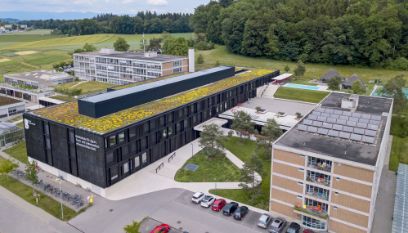
The BFH-HAFL campus is located in Zollikofen, near Bern. Nestled among fields and forests, the location offers both the modern infrastructure you need for your studies and countless recreational options.
The majority of the classes take place on the BFH-HAFL campus in Zollikofen – in lecture halls, modern laboratories, or in the dedicated technology hall. The laboratories and technical facilities of the HES-SO Valais-Wallis in Sion are also available for your master's thesis.
The BFH-HAFL campus in Zollikofen offers modern lecture halls, laboratories, and experimental fields. However, the campus is not only a place for learning. With a swimming pool, barbecue areas, a sauna, and much more, it also offers a wide range of recreational activities. In addition, there is a student dormitory on the campus with around 140 furnished rooms and a cafeteria.