- Story
How can we create spaces where people feel safe?
16.11.2026 Safety does not happen by itself. It depends on people taking responsibility for one another within society. Police and security alone do not create a sense of safety.
Key points at a glance
- Safety requires spaces where people are attentive to one another, practice care and assume mutual responsibility. Such spaces are often referred to as caring spaces or safer spaces.
- In addition to the police, security staff and medical services, awareness work contributes to people’s sense of safety in public spaces, particularly at public events.
- At BFH, awareness and a culture of shared responsibility are also highly valued.
Our society is changing. Public debates have become more polarised, social uncertainties are on the rise and tolerance towards other ways of life is coming under increasing pressure. In light of this, how can we create environments in which people feel safe, respected and welcome?
Safety is more than just the absence of danger. It influences whether people take part in social life, use public spaces or attend events. People who are afraid of discrimination, harassment or exclusion are more likely to withdraw.
Would you like to learn more about awareness work?
Join us at our workshop on 2 December 2026. We will present our findings, discuss concrete opportunities for action and take the opportunity to exchange ideas and network with experts and practitioners. An informal lunch and apero are included. We would be delighted if you could join us as we work together to strengthen awareness competencies.
Date
Wednesday, 2 December 2026
Time
12.30pm – 4pm
Where
Bern University of Applied Sciences, Schwarztorstrasse 48, 3007 Bern
Registration deadline: 23.11.2026.
Event organisers, educational institutions and civil society organisations are seeking ways to foster a culture of mutual respect. At the heart of this is the concept of ‘safer or caring spaces’ – spaces that promote safety not primarily through control and sanctions, but through attention, care and mutual responsibility.
This principle is at the core of the research project CARES – Caring & Awareness Work for safety and inclusion, which is supported by the strategic thematic field Caring Society at Bern University of Applied Sciences. The three researchers – Nada Endrissat and Lea Graf from the Business School, and Yvonne Schmidt from HKB – are investigating together how such spaces can be designed.
The term ‘safer’ highlights the fact that absolute safety can never be guaranteed. Instead, the objective is to establish conditions that prevent discrimination and violations of boundaries, thereby increasing the likelihood of safety.
Awareness at events
Such approaches are gaining in visibility at festivals and large-scale events. Where large numbers of people with diverse backgrounds and needs come together, conflicts or boundary violations are more likely to occur. That is why more and more event organisers are turning to awareness initiatives and teams.

Awareness teams are regarded as a relatively new form of civic engagement. Unlike the police, security staff or medical services, they are not responsible for enforcing rules and laws or ensuring physical safety. Instead, they provide a point of contact for people who feel uncomfortable, are experiencing discrimination or need support in difficult situations.
Their work requires tact and the ability to assess situations individually. They observe, listen and help situations deescalate without intervening prematurely.
In many contexts, awareness work is supported by both professional organisations and dedicated volunteers. Consistent standards and a shared understanding of roles are still taking shape.
A case study: Buskers Bern
‘Buskers Bern’ is under close scrutiny by the CARES research team. As part of its awareness and safety concept, the festival works with various stakeholders, including the organisation ‘Taktvoll’, the campaign ‘Bern is paying attention’ and the police. The different teams are present on the festival grounds and serve as low-threshold points of contact for attendees.
This highlights the complexity of creating safer spaces:
- What does safety mean for different people?
- Whose needs are recognised and taken into account?
- How can differing or conflicting needs be reconciled?
- Who is protected by specific measures, and who may be excluded as a result (for example, homeless people)?
Safer spaces are not only a matter of security, but also of participation, access and responsibility. CARES examines the practices that support this, with the aim of developing recommendations that help shape public spaces as caring spaces.
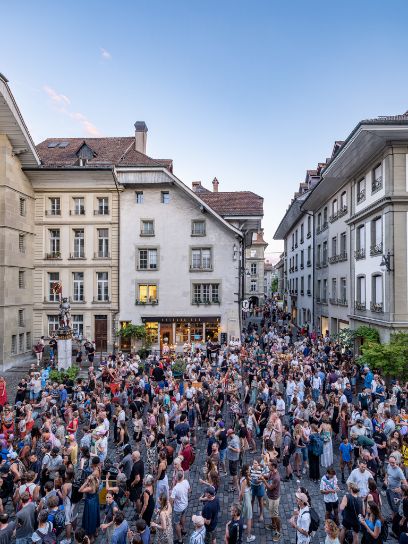

An increasing number of festival organisers regard awareness work as an integral part of their role as hosts.
Initial findings show that an increasing number of festival organisers regard awareness work as an integral part of their role as hosts. They want to create spaces where people feel safe and welcome. However, there are differences in how this is put into practice. Some organisers rely on (their own) awareness teams, whilst others use codes of conduct or similar measures.
At the same time, it becomes clear that awareness is not determined by concepts alone. What matters most is how attention, respect and care are put into practice throughout the festival. However, many organisers face limitations in terms of staffing, funding or expertise in the field. Furthermore, cooperation with security staff and the police is organised differently, raising questions about responsibilities and roles.
From research to practice at BFH
The question of how to make events and shared spaces safer is a top priority at BFH also. The Equal Opportunities Office is developing guidelines to effectively embed awareness in various contexts across the BFH.
There are already some initial steps being taken. At the Business School, Matthias Stürmer and the Equal Opportunities officers initiated a code of conduct for events that outlines principles for respectful interaction and identifies sources of support for individuals who experience harassment. A key rule is: no comments on other people’s appearance. The code of conduct was introduced following a series of isolated incidents at a conference, which led to calls for specific guidelines.
Participation is key
Experience shows that raising awareness alone can already make a difference. The code of conduct is sent before and displayed during events. Since its introduction, instances of inappropriate behaviour have declined. According to Matthias Stürmer, regular training on how to respond to incidents is equally important. So far, the efforts have focused primarily on people in leadership roles. A short training session for everyone could further strengthen awareness at BFH.
Ultimately, however, the issue is not primarily about introducing additional rules, but about fostering a culture of mutual responsibility.
It is not about introducing additional rules, but about fostering a culture of mutual responsibility.
The roots of awareness work point to a broader idea of society: safety and care are not solely the responsibility of public institutions, but a shared responsibility of society as a whole. This is closely linked to the vision of a caring society, one in which care is understood as a collective social duty. This requires knowledge, resources and a willingness to include diverse perspectives and needs.