Architecture

Design regenerative architecture using local materials and shape cooperative urban development in a practical way – your master’s degree for the future and the environment.

The thematic focuses of the Joint Master in Architecture (BFH & HES-SO) address current architectural and social challenges. At the study locations in Biel/Bienne, Fribourg and Geneva, you benefit from a wide range of expertise and practical projects for a liveable, sustainable environment.

The students of the Joint Master of Architecture are building a self-designed concert pavilion on the shores of Lake Biel.

Start your degree programme in the autumn or spring semester.

Factsheet

  • Title/Degree Master of Arts (MA) in Architecture
  • Specialisations «Regenerative architecture & wood»
    «Cooperative architecture of the open city»
  • Mode of study Full-time (4 semesters), Part-time (7 semesters)
  • Start date Spring semester: week 8
    Autumn semester: week 38
  • Application deadline Spring semester: 31 October
    Autumn semester: 31 May
  • ECTS credits 120 ECTS
  • Teaching language German (English, French)
    Common modules with students from Fribourg and Geneva are taught in English and French. All written work can be submitted in German, English or French.
  • Location Biel city lab, individual seminars in Fribourg and Geneva
  • School School of Architecture, Wood and Civil Engineering

Focus areas

You will gain in-depth specialist knowledge in conceptual and constructional design in the two focus areas of ‘Architecture & Wood’ and ‘Architecture & Area. You will gain an insight into applied research and innovative practice, opening up your prospects.

What you will gain from your degree

With the Joint Master in Architecture at BFH and HES-SO, you acquire the ability to manage complex design and planning tasks, from strategic concepts to competition projects and realisation. The course combines regenerative construction methods and cooperative urban development with applied research and innovative practice.
You broaden your professional perspective, prepare yourself for the role of project manager in Switzerland or abroad and build a strong network.
The programme offers you valuable time and space to develop your own architectural stance and define it in a master’s thesis of your choice with a practical focus at the study locations in Biel/Bienne, Fribourg and Geneva.

The focus areas

Choose your main topic and design your studies according to your interests.
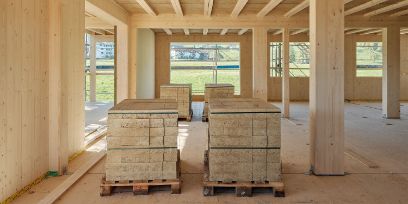
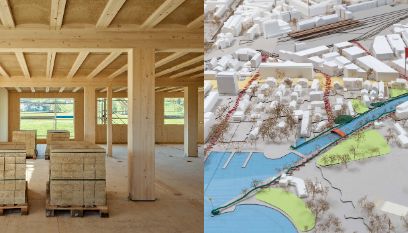
The focus area ‘Regenerative architecture & wood’ provides extensive expertise in timber building culture and the use of wood as a material. You combine wood with resource-conserving, bio-based building materials such as clay, natural fibres and natural stone to generate sustainable building concepts.

Your benefits

  • Practical know-how: you learn to improve traditional Baukultur and combine it with modern planning and production methods.
  • Future-oriented competence: you qualify for resource-conserving construction that is eco-friendly, cost-effective and competitive.
  • Comprehensive approach: you consider the interplay between ecosystems, energy cycles and material cycles and design architecture in harmony with natural processes.
  • Social impact: by using regenerative construction methods, you improve indoor and urban climates, thereby contributing to climate-friendly cities and settlements.
  • Career prospects: you position yourself as an expert in sustainable architecture, gaining access to attractive opportunities in Switzerland and abroad.

schwerpunkt regenerative architektur

In the focus area ‘Cooperative architecture of the open city’, you acquire the skills to grasp complex social, economic and environmental correlations pertaining to neighbourhood and urban development. You learn how to operate successfully within the context of dynamic urban and settlement development using cooperative and interdisciplinary practices.

Your benefits

  • Practical work: you develop projects in close collaboration with local stakeholders, authorities and the population.
  • Interdisciplinary competence: you benefit from the exchange with experts from the fields of architecture, urban planning, sociology, economics and environmental sciences.
  • Added value for society: you design sustainable development processes that improve the quality of our built environment in the long term.
  • Future-oriented perspective: you qualify for responsible roles in urban planning, architecture and project management in Switzerland and abroad.
  • Creative freedom: you contribute your ideas and play an active role in shaping the development of liveable, open cities.

schwerpunkt kooperative stadtentwicklung

Joint Master: highlights + admission

The Joint Master of Architecture (JMA) is offered jointly by Bern University of Applied Sciences (BFH) and the University of Applied Sciences and Arts of Western Switzerland (HES-SO). With over 20 years of experience, it is one of the most well-established master’s degree programmes in Switzerland, combining practical teaching with interdisciplinary research.

1 Master – 2 universities – 3 sites

The courses take place at three different sites: at the School of Architecture, Wood and Civil Engineering of Bern University of Applied Sciences in Biel, at the Fribourg School of Engineering and Architecture, and at the Geneva School of Landscape, Engineering and Architecture.

Benefits of the Joint Master of Architecture (JMA)

To become a student of the Joint Master of Architecture, you register either with BFH or HES-SO. You have access to all the modules offered at JMA locations:

  • Broad range of courses: you have access to all modules at the three locations and you can design your studies individually according to your interests and the skills you wish to acquire.
  • Flexibility: the master’s programme can be completed full-time or part-time, making it an ideal solution if you wish to combine your studies with your career or personal projects.
  • Development of an individual profile: you select focus areas that match your goals and develop a clear competence profile for your career.
  • Interdisciplinary range of modules: the various locations bring together different perspectives and expertise – a plus for your education.
  • Attractive prospects: thanks to practical projects and a strong network, you will be optimally prepared for responsible roles in architecture and urban development.

Admission requirements

To be admitted to the Joint Master of Architecture (JMA), you must have one of the following qualifications:

  • A bachelor’s degree in architecture from a Swiss university of applied sciences
  • A bachelor’s degree in architecture from a Swiss university, plus a practical work placement
  • Other qualifications and programmes abroad: bachelor’s degree in architecture or equivalent training recognised by the guidelines of the European Union or the European Association for Architectural Education (EAAE) and professional internship.

Detailed information on admission requirements and applications can be found on the website of the Joint Master of Arts in Architecture.

Advice + information

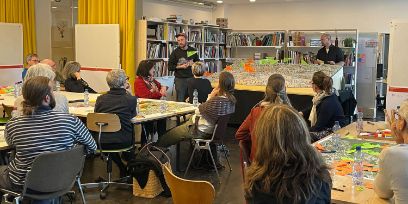
Do you have any questions about the degree programme? The head of programme, lecturers and students will answer your questions at our info events.

Advice

Your choice of education or continuing education programme is a major decision. We would be pleased to offer you a personal consultation to answer your questions and explain the requirements for the programme you are interested in.

Beratung Studiengänge

Personal advice

Study advice in a few clicks: Stanislas Zimmermann will be happy to answer all your questions about your studies.

Simply book an appointment online or on site!

Info event

Our online info events tell you all you need to know about our programme, our admission requirements and your subsequent career prospects. Our students give you their personal take on daily life on campus and share their experiences.

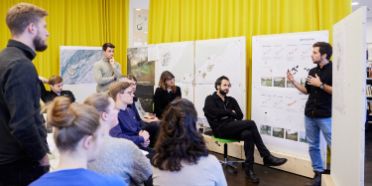
In addition, you can visit us at an Open Atelier day at the Biel city lab.

Location + facilities

You will study for the Master in Architecture at the Biel city lab in the heart of the city. This is also home to the Dencity research competence area, which focuses on spatial development topics. The city lab is an initiative of the Biel professional and interest associations, the City of Biel and Bern University of Applied Sciences.

Location

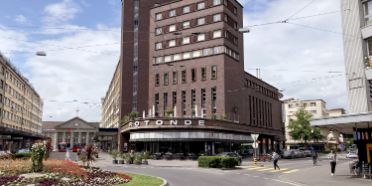
The Biel city lab can be reached in around 3 minutes on foot from the railway station. 
No parking spaces are available at the Biel city lab. Parking is available at the “Bahnhofparking” car park.
Aarbergstrasse 112, Biel/Bienne

Bern University of Applied Sciences

School of Architecture, wood, civil engineering
Stadtlabor Biel
Aarbergstrasse 112
CH-2502 Biel/Bienne

+41 34 426 42 33

masterarchitektur.ahb@bfh.ch

Bern University of Applied Sciences

School of Architecture, wood, civil engineering
Stadtlabor Biel
Aarbergstrasse 112
CH-2502 Biel/Bienne

+41 34 426 42 33

masterarchitektur.ahb@bfh.ch

Infrastructure

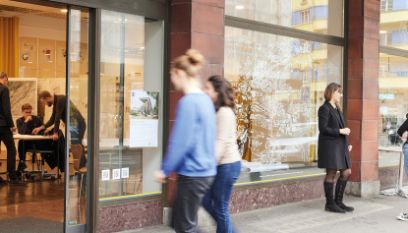
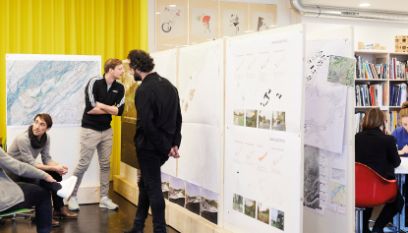
As a student you will get a personal workplace on the ground floor. The large window provides great views of vibrant city life. There are also a library and workspaces for lecturers and employees on the ground floor.

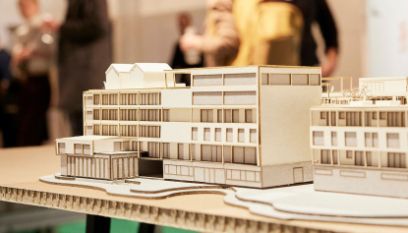
On the basement level, you have access to a small workshop for model construction as well as plotters and printers for your presentations.

Biel, Aarbergstrasse 112

This video (in German) shows two master's students, Mahdi Bagheri and Lamya Zayakh, with their thesis projects at the Expo site and the railway station area in Biel. The topics are resource-efficient construction and urban climatology.
(Post from July 20, 2023)