Regulatory Affairs in Life Sciences

The CAS Regulatory Affairs in Life Sciences provides a comprehensive understanding of the regulatory frameworks applicable to medical devices, in vitro diagnostic medical devices (IVDs), and medical software.

Factsheet

  • Degree/Certificate Certificate of Advanced Studies (CAS) Regulatory Affairs in Life Sciences
  • Duration Week 43 to week 14
  • Schedule Friday: 1pm to 7.30pm
  • Application deadline 23 September
    9–24 participants
  • ECTS credits 12 ECTS-Credits
  • Costs CHF 7’850
  • Teaching language English
  • Location Biel, Aarbergstrasse 46 / Online
  • School School of Engineering and Computer Science
  • Next session Autumn semester 2026

Start your continuing education on 23 October 2026.

Structure + Content

The CAS Regulatory Affairs in Life Sciences focuses on the regulations for medical devices, in vitro diagnostics, and medical software.

Objectives + Skills

Environment

Medical devices, in vitro diagnostic medical devices, and medical software are developed, manufactured, and marketed within a highly regulated environment. Their successful lifecycle management requires expertise in regulatory affairs, quality management, and risk management.

In this CAS, you develop an understanding of the applicable standards, regulations, and industry practices, and learn how regulatory affairs, quality management, and product development interact throughout the product lifecycle.

For a deeper understanding of pharmaceutical product regulations, we recommend the CAS Regulatory Affairs Pharma

Career opportunities

Typical positions include Regulatory Affairs Specialist, Regulatory Affairs Manager, Regulatory Affairs Consultant, and Regulatory Compliance Specialist.

The knowledge gained in this CAS is also relevant for professionals working in product development, engineering, manufacturing, project management, and other functions involved in the development, market access, and lifecycle management of healthcare products. It enables you to communicate effectively across multidisciplinary teams and to contribute to regulatory compliance throughout the product lifecycle.

Depending on your professional background and experience, you may also support or assume responsibilities associated with the Person Responsible for Regulatory Compliance (PRRC) as defined in Article 15 of the EU Medical Device Regulation (MDR).

Education goals

Upon completion of the CAS, you will be able to:

  • Apply the key regulatory requirements governing medical devices, in vitro diagnostic medical devices (IVDs), and medical software, including relevant frameworks in Switzerland, the European Union, and the United States.
  • Establish and maintain compliant quality management and risk management processes, taking into account standards such as ISO 13485 and related regulatory requirements.
  • Apply principles of design control, usability engineering, validation, and post-market activities to support the development, market access, and lifecycle management of medical devices.
  • Evaluate regulatory, quality, and cybersecurity requirements for digital health technologies, connected medical devices, and medical software.
  • Understand the fundamentals of artificial intelligence in the life sciences industry, including current applications, regulatory considerations, and how to turn Trustworthy AI principles into practice.

Testimonial

Testimonial Seiko Jodry
Seiko Jodry, Graduate

The continuing education program in Regulatory Affairs in Pharma and Life Sciences provides an excellent foundation for understanding global regulatory frameworks. It is helping me strengthen my expertise in regulatory affairs and bridge my prior experience in pharmacovigilance with new regulatory knowledge. It offers a perfect balance of academic and real-world learning.

The learning concept of this CAS combines theoretical knowledge with practical application. Participants acquire competencies through contact studies, individual self-study, a semester project (Living Case), and an expert discussion at the end of the program.

Learning unit Duration Description
Contact studies ~ 130 lessions
(20–21 course days)
Classroom-based learning delivered in on-site, remote, or hybrid format. Contact studies include lectures, workshops, case studies, practical exercises, and discussions led by experienced industry experts.
Semester project 115 hours Application of acquired knowledge to a real-world regulatory challenge from your professional environment or an independently selected topic. The semester project is typically conducted in small groups and supervised by industry experts with expertise in the respective project area. The project culminates in a written report and project presentations.
Individual self-study 40-60 hours Self-directed learning to prepare for classes, consolidate acquired knowledge, review course materials, and prepare for assessments.
Expert discussion ~ lession At the end of the CAS, you analyse and defend selected aspects of your semester project in a discussion with your industry expert and the CAS lead, drawing on the knowledge and competencies acquired throughout the program.
CAS = 12 ECTS credits (360 hours)


Overview regulations

  • CH and EU regulations
  • Introduction to the MDR
  • Introduction to the IVDR
  • Introduction to the GDPR
  • International regulations
  • Global RA strategy

Overview of US Market Access, Regulation, and Compliance for MDs

  • Market access in the United States, legislation, and organization of the FDA.
  • Medical devices in the United States
    • Medical device definition
    • Product classification
    • Workshop
  • Marketing and distribution, establishment registration and device listing
     

Fundamentals of FDA Premarket Submission

  • Premarket submissions (overview)
    • Premarket Notification 510(k)
    • Investigational Device Exemption (IDE)
    • Premarket Approval (PMA)
    • De Novo classification request
    • Humanitarian Device Exemption (HDE)
    • Q-Submission Program
    • Considerations preparing Premarket submissions, FDA guidance documents and databases
  • Premarket Notification 510(k) (in detail)
    • 510(k) types and FDA processing
    • Structure of the traditional 510(k)
    • Workshop
       

U.S. Quality Management System Requirements

  • U.S. FDA requirements to QMS (basics)
  • QSR/QMSR
  • 21 CFR Part 11 e-records, e-signatures
  • MDR, correction and removals, recalls
  • 21 CFR Part 803 Medical Device Reporting (MDR)
  • 21 CFR Part 806 Reports of corrections and removals
  • 21 CFR Part 7 Recalls/Part 810
     

FDA Inspections and Market Protection

  • FDA Inspections
  • Quality System Inspection Technique (QSIT)
  • Practical tips for FDA inspection preparation
  • Market protection

Quality and risk management

  • QMS ISO 13485
  • Biomaterials and biocompatibility
  • Biological evaluation of medical devices according to ISO 10993
  • Risk management for medical products
  • Documentation
  • Human centered product development

Product engineering

  • Software life cycle process according to IEC 62304
  • Software as a medical device (SaMD)
  • Product engineering – practical implementation
  • Design control for combination products
  • From requirement to design transfer
  • From design transfer to phase-out
  • Packaging and labelling of medical devices

Validation and operation

  • Medical device audits according to ISO°19011:2018
  • Computer system validation
  • Implementation in the market (vigilance)

Digitalization and cybersecurity in life sciences

  • Digitalization in Life Sciences
  • Cybersecurity
  • Artificial Intelligence (AI) and Machine Learning (ML)

Trustworthy AI in the Life Sciences industry

Analyze – Clarify the Trustworthy AI Landscape

  • Why Trustworthy AI: Fundamental concepts (e.g. EU HLEG- Ethics Guidelines for Trustworthy AI, NIST AI RMF)

Architect – Design for Trust

  • Integrating Trustworthy AI into your ways of working on an organizational and project level

Anchor – Make Trust Operational

  • Validation strategies, acceptance criteria, and evidence for release decisions

Semester project (living case)

  • Semester work
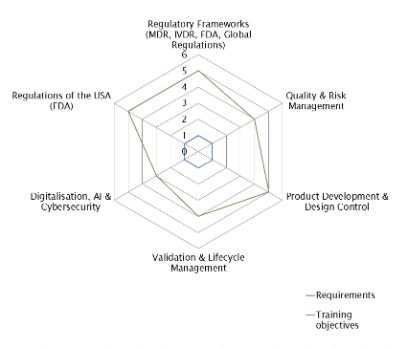
Skills profile CAS Regulatory Affairs Life Sciences Enlarge image

Bloom's taxonomy of learning objectives

  1. Knowledge: Reproduce what has been learned by heart.
  2. Comprehension: Explain, reformulate, or paraphrase what has been learned.
  3. Application: Apply what has been learned in a new context/situation.
  4. Analysis: Break down what has been learned into components, explain structures.
  5. Synthesis: Reassemble what has been learned or generate new content.
  6. Judgement: Critically evaluate what has been learned according to (mostly self-) chosen criteria.

For the 12 ECTS credits to be recognized, successful completion of the competency assessment is required (exam, semester work).

Markus Angst
Tech Doc and RA Consultant, AtlantiQ Consulting
Lecturer BFH

Marco Cuomo
Managing Director, Cuomo IT Consulting GmbH
Lecturer BFH

Christina Degen-Wendlinger
Senior Consultant, inmedis AG
Lecturer BFH

Dr. med. Katharina Friedrich
Founder and Consultant for Regulatory and Medical Writing, Katylistic GmbH
Lecturer BFH

Sandra Item
CEO and Owner, ISS Integrated Scientific Services AG
Lecturer BFH

Holger Kloess
Senior Consultant, QUNIQUE GmbH
Lecturer BFH

Muriel Künzi
Attorney at law, Owner BKS Rechtsanwälte AG
Lecturer BFH

Darlene MacDonald
Consultant, Cuomo IT Consulting GmbH
Lecturer BFH

Michael Maier
Advisor MMEX GmbH
Lecturer BFH

Larissa Naber
Co-Founder PROREGIA AG
Lecturer BFH

Andrea Schütz Frikart
Head of Industry Engagement Healthcare, GS1 Switzerland
Lecturer BFH

Nadine Schwarz
Senior Consultant, meditec Consulting
Lecturer BFH

Valentina Shcherba
Senior Consultant, QUNIQUE GmbH
Lecturer BFH

Sandra Soniec
Founder meditec Consulting
Lecturer BFH

Beat U. Steffen
Founder and Principal Consultant, Confinis AG

Lutz Stehling
Senior Consultant, inmedis AG
Lecturer BFH

Erich Studer
Geschäftsführer Mecomis GmbH
Lecturer BFH

Fabienne Weiss 
Head of MAS Regulatory Affairs & Lecturer BFH

Degree + Title

Certificate of Advanced Studies (CAS) in «Regulatory Affairs in Life Sciences»

Statement

Christina Degen-Wendlinger

Christina Degen-Wendlinger
Senior Consultant, inmedis GmbH
 

“I am impressed how the students of the CAS Regulatory Affairs in Life Sciences combine the knowledge acquired in the seminars with practice in their case studies, resulting in well-founded new implementation solutions. In my opinion, this is what makes the MAS Regulatory Affairs stand out. The students are specifically prepared for the challenges of their working world.”

Requirements + Admission

Find out which professionals this continuing education program is designed for and what requirements you need to bring with you.

Target audience

You are involved in the development, manufacture, market access, or lifecycle management of medical devices, in vitro diagnostic medical devices, or medical software. This CAS is particularly relevant if you wish to strengthen your expertise in regulatory affairs and gain a deeper understanding of quality management, risk management, compliance requirements, and emerging technologies such as artificial intelligence within the regulated healthcare environment.

Requirements

  • You have a degree in engineering, medical technology, medical informatics, life sciences, pharmacy, medicine or veterinary medicine.
  • You have relevant professional experience in the medical device or related regulated healthcare industries.

Language

The teaching language and the course materials are in English.

As a rule, a university degree and practical experience are required for admission. 
People with a high vocational training can apply, provided they have suitable professional experience and prior scientific and methodological knowledge. 

Infoevent + Course guidance

Do you have questions about the programme? The head of degree programme, CAS heads, and lecturers will answer your questions at our information events.

Location

This CAS is delivered remotely, in a hybrid format or on-site at Aarbergstrasse 46 in Biel. The teaching format for each session is indicated in the timetable.

Switzerland Innovation Park Biel/Bienne (SIPBB)

A location with many advantages

  • Classrooms within two minutes walking distance from Biel/Bienne railway station
  • Ideal train connections from Bern’s main railway station (every 15 minutes) and from Bern Wankdorf (every 30 minutes)
  • State-of-the-art infrastructure in the new SIPBB building
  • Various catering options in the immediate vicinity
  • Innovation and networking events

And that’s not all! Biel/Bienne is…

  • an innovation hotspot,
  • a university city,
  • an industrial and service city with numerous major players in the watchmaking, mechanical engineering, precision engineering and medical technology industries and major representatives of the communications and telecommunications sectors,
  • bordered by Lake Biel and its wide range of sports and leisure facilities,
  • a city that embodies bilingualism,
  • a town with a vibrant cultural life.

Biel Aarbergstrasse 46 (Switzerland Innovation Park Biel/Bienne)

Biel, Aarbergstrasse 46

Bern University of Applied Sciences

Engineering and Computer Science
Switzerland Innovation Park Biel/Bienne
Aarbergstrasse 46
CH 2503 Biel

Bern University of Applied Sciences

Engineering and Computer Science
Switzerland Innovation Park Biel/Bienne
Aarbergstrasse 46
CH 2503 Biel