Geotech SENKATO: Stability of Landfill Bodies
Analysis of the geotechnical properties of Type D landfill bodies. The results enable a more efficient use of limited landfill capacity while considering the evolving characteristics of incineration residues from MVI plants.
Factsheet
- Schools involved School of Architecture, Wood and Civil Engineering
- Institute(s) Institute for Infrastructure and Environment IIU
- Research unit(s) Geotechnics and Special Civil Engineering group FGGS
- Strategic thematic field Thematic field "Sustainable Development"
- Funding organisation Others
- Duration (planned) 01.06.2025 - 31.12.2026
- Head of project Sebastian Schaller
-
Project staff
Christoph Hert
Prof. Roman Gallus
Gabriel Bächler -
Partner
VBSA
Kanton Bern
Kewu AG
ZAKU AG
kenova AG
Gravière des Tuileries SA
FAMSA SA
GEVAG - Keywords Geotechnics, Landfills, Laboratory Testing, Field Testing, Incineration Residues
Situation
In Switzerland, municipal waste generation amounts to approximately 670 kg per capita per year " 1 ", of which nearly half is incinerated in municipal waste incineration (MWI) plants " 2 ". The resulting incineration residues, namely bottom ash and fly ash, must be landfilled. For bottom ash alone, landfill demand amounts to around 500,000 m³ per year nationwide, which corresponds roughly to the volume of 200 Olympic-sized swimming pools. Most of this material is disposed of in dedicated Type D landfills. However, available landfill capacity is becoming increasingly scarce. In many cantons, existing capacities are expected to be exhausted as early as the 2030s, while surveys of the Swiss Association of Landfill Operators indicate that the secure disposal of bottom ash will already come under significant pressure by the end of this decade " 3 ". The development of new landfill sites is highly challenging. Consequently, the more efficient use of existing landfill capacity is becoming increasingly important. At the same time, the composition of incineration residues is changing. The expansion of metal recovery, the introduction of new treatment technologies, and the optimization of bottom ash treatment will alter the properties of materials destined for landfilling in the future.
Course of action
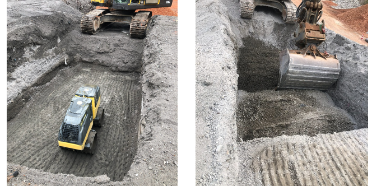
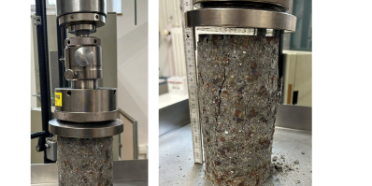
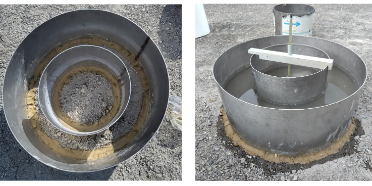
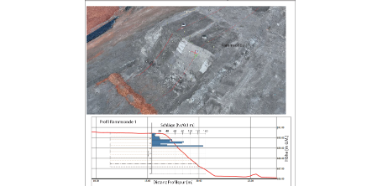
This project investigates the current and future composition of incineration residues from MWI plants and their long-term stability. Due to optimized treatment processes introduced in recent years, bottom ash is becoming increasingly finer-grained and exhibits lower moisture contents. These changes affect its geotechnical and chemical properties and, consequently, the stability of landfill bodies. Laboratory testing carried out at the BFH Geotechnics Laboratory provided insights into compactability, slope stability, development of compressive strength, volumetric behaviour, and erosion susceptibility of five different bottom ash mixtures. To investigate behaviour under field conditions, two test embankments consisting of different mixtures of bottom ash and fly ash were constructed at the KEWU AG Laufengraben landfill site in Krauchthal (BE), Switzerland. These test embankments represent the range of material properties and constituent proportions observed today and expected in the future. To draw conclusions regarding long-term behaviour, the geotechnical properties of the test sections are being assessed over several months using dynamic cone penetration tests and infiltration measurements. To monitor potential settlement, heave, and lateral displacement, 20 monitoring points were also installed and are regularly surveyed using laser tachymetry.
Result
Laboratory testing enabled a more detailed characterization of the geotechnical properties of current bottom ash compositions and those expected in the future. Compared with the typical bottom ash composition currently encountered, future bottom ashes are expected to exhibit improved compactability, allowing larger quantities of material to be placed within the same available landfill volume. The mechanical properties of the newly tested mixtures also tended to be more favourable than those of the reference mixture, although a high sensitivity to water was observed for some mixtures during laboratory testing. The results demonstrate that changes in bottom ash composition bring both opportunities and challenges. Thanks to this research, the future impacts associated with evolving incineration residue properties could be anticipated, enabling appropriate measures to be planned for Type D landfills. The knowledge gained also provides an important basis for ensuring the stability of landfill bodies and reducing the long-term risk of slope failures.
Looking ahead
Although the recycling rate in Switzerland is high, the large quantities of waste generated continue to have significant environmental impacts, particularly in terms of landfill capacity requirements. The most effective way to reduce these landfill demands is to prevent waste generation and promote reuse and recycling. For waste incinerated in MWI plants, however, a better understanding of the geotechnical properties of bottom ash can help make more efficient and safer use of the limited landfill space available. The Geotech SENKATO project provides important insights into the properties of current and future bottom ash mixtures. It takes into account future bottom ash compositions with lower metal contents resulting from improved treatment processes, as well as higher proportions of fly ash and wood ash, which may become more common in the future due, for example, to the increasing use of wood-based heating systems. Through this project, BFH, in collaboration with several Swiss landfill operators, the Swiss Association of Landfill Operators, and kenova AG, contributes to the sustainable development of Switzerland. The research enables the early identification of the impacts of new industrial technologies on the environment, safety, and waste management, as well as their implications for how waste should be managed in the future.