Standardized testing and assessment of ballast bonding
In collaboration with Allianz Fahrweg, the BFH geotechnical laboratory has developed a standardized testing protocol to reliably evaluate and compare the technical performance of various ballast adhesives.
Factsheet
- Schools involved School of Architecture, Wood and Civil Engineering
- Institute(s) Institute for Infrastructure and Environment IIU
- Research unit(s) Geotechnics and Special Civil Engineering group FGGS
- Strategic thematic field Thematic field "Sustainable Development"
- Funding organisation Others
- Duration (planned) 01.01.2023 - 31.12.2026
- Head of project Femi Reshiti
- Project staff Christoph Hert
-
Partner
Allianz Fahrweg Normalspur
SBB AG - Keywords Geotechnical Laboratory, Ballast Bonding, Adhesive Testing, Compression Test
Situation
Railway ballast is a key component of the track structure and is used in large quantities for track renewal and maintenance. Swiss Federal Railways (SBB) uses around 600,000 tonnes of railway ballast each year for the maintenance and renewal of its railway network 1 . During construction and maintenance works, ballast often needs to be stabilized locally, for example when a siding is excavated without affecting the stability of the adjacent main track. For this purpose, ballast adhesives are used to locally strengthen the ballast bed. This enables excavation works to be carried out while the adjacent main line can, under certain conditions, serve as a working platform for heavy construction vehicles. However, until now, no standardized method existed to assess the technical performance of such adhesives under defined conditions and to compare different products objectively. Demonstrating performance is particularly important for safety-critical applications. Therefore, Allianz Fahrweg Normalspur and BFH developed a standardized testing protocol for ballast bonding, enabling a uniform assessment of adhesives used for ballast stabilization.
Course of action
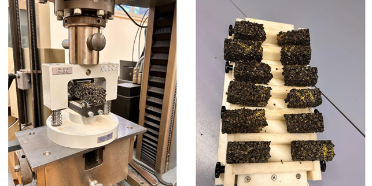
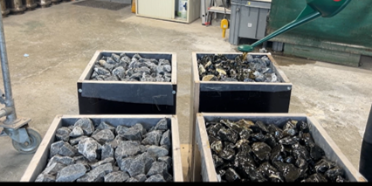
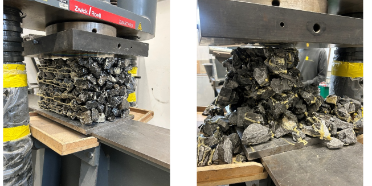
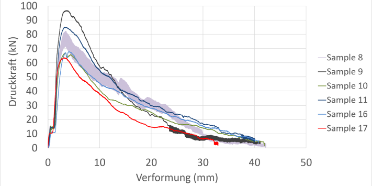
To enable the assessment of ballast adhesives under comparable conditions, a standardized testing procedure was progressively developed at the BFH Geotechnical Laboratory. Different ballast preparation methods were investigated to evaluate the influence of its compactness and fine-particle content on bonding performance. A simple yet robust adhesive application procedure was also developed, enabling the testing of different adhesives with potentially varying viscosities. For the mechanical testing, ballast specimens with a base area of 30 × 30 cm and a height of 50 cm were prepared. After bonding and demolding, the specimens were loaded in different directions using a testing press. Deformation was applied at a controlled rate of 1 mm/min. The findings were used to identify the most relevant testing parameters and to incorporate them into the final testing protocol or, respectively, into the corresponding requirements. Expected differences between laboratory and field conditions were also considered during the development of the procedure.
Result
The testing protocol developed as part of the project defines minimum requirements for assessing the technical performance of ballast adhesives for the first time. The evaluation is based on both mechanical criteria and criteria related to the uniformity of the bond throughout the full depth, while maintaining the initial porosity of the ballast. Based on this test protocol, various adhesives from different manufacturers were tested. The target values defined by the protocol made it possible to confirm or reject the performance of these products, enabling Allianz Fahrweg Normalspur to guarantee a minimum quality standard for its products even before their first use.
Looking ahead
The developed testing protocol provides a standardized basis for testing and comparing adhesives from different manufacturers under reproducible conditions. In this context, the BFH Geotechnical Laboratory plays an important role as an independent testing body for assessing the technical performance of ballast adhesives. This enables new products to be evaluated against the same minimum requirements and supports a broader range of suitable adhesives. Further studies may contribute to the refinement of the testing procedure, investigate its applicability to additional ballast bonding applications, and improve the correlation between laboratory results and field conditions.